Loneliness and isolation
I Am LegendLoneliness and isolation form the central human condition of Robert Neville’s life after the plague. They are not merely the absence of company: they govern his habits, distort his desires, intensify his grief, and make every possible human connection appear both miraculous and dangerous. His fortified house protects him from the vampires, but it also becomes the enclosure in which he listens, remembers, drinks, studies, and tries to persuade himself that solitude is survivable.
Physical Enclosure and Daily Survival
Robert Neville’s isolation is first imposed by the altered world around him. Each night, the vampires gather outside his house, and after five months their presence remains an assault he can hear even when he refuses to look at them. He once made a peephole in the front window to watch them, but stopped after the women saw him and struck obscene poses to entice him outside. He can block the noise with earplugs, yet doing so would also shut out the music he uses to preserve a sense of inner life. The house therefore functions as both shelter and trap: its walls keep the vampires away, while their voices and gestures keep reminding him that he is surrounded.
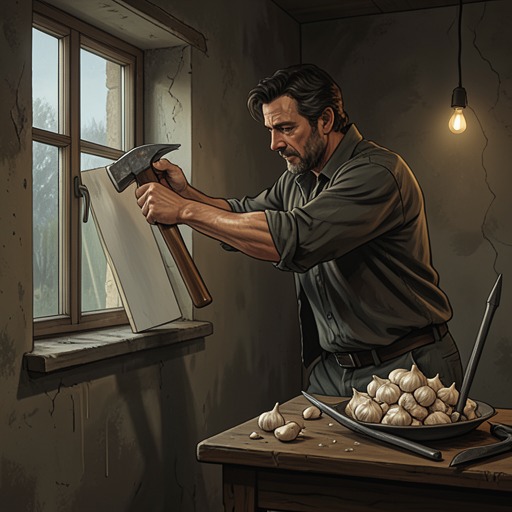
His isolation is also enacted through repetitive labor and deliberate neglect. He repairs the defenses, gathers garlic from the hothouse, burns bodies, and removes the rocks used by the vampires, but ordinary domestic maintenance has lost its meaning. After allowing garbage to accumulate for five days, he recognizes that he should burn the paper plates, clean the furniture and plumbing, and change the bed linen, yet concludes that, because he is a man and alone, these tasks have no importance. The statement reduces domestic order to a social activity whose value disappears when there is no one left to share the house with.
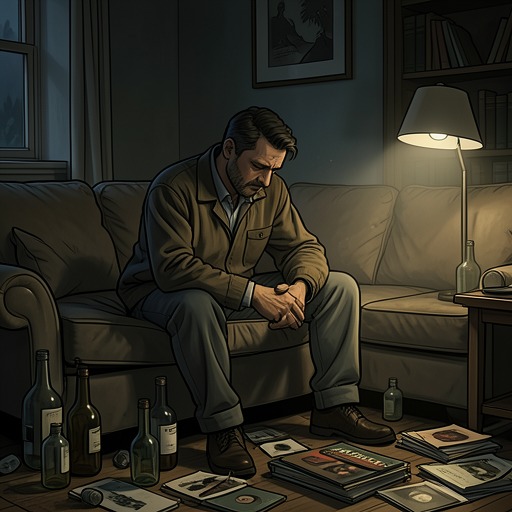
The nightly assault turns physical separation into psychological pressure. Robert Neville reads, listens to music, drinks, or starts a film to keep from hearing the figures outside. Beneath these diversions, however, a knotting heat rises through his body: sexual craving he cannot defeat by reason. He paces with bloodless fists, turns the music painfully loud, eats, drinks too much, or searches for another distraction. The books before him contain centuries of knowledge, but they cannot extinguish what he experiences as the wordless demand of his flesh. Solitude thus does not produce calm; it exposes him to impulses that the social world once disciplined or concealed.
Bereavement and the Refusal of Final Separation
The isolation surrounding Robert Neville is deepened by the losses that preceded his solitary life. When he approaches the crypt containing Virginia Neville’s casket and finds the iron door ajar, fear briefly overwhelms him. He runs across the wet grass imagining that the vampires may have violated her remains and vows to burn the city if they have touched her. The sealed casket is still untouched, and the immediate crisis passes, but the scene reveals that Virginia Neville remains an active presence in his emotional world. Even after death, she is someone he must protect.
His resistance to the plague law makes that attachment concrete. He knows that infected bodies are supposed to be burned, yet cannot accept that husbands should consign their wives to flames or that parents should burn their children. He refuses to let Virginia Neville be destroyed in the fire. After an hour of indecision, he uses her needle and thread to sew a blanket over her body until only her face is visible, then covers her mouth, nose, and eyes. The action is both care and concealment: he tries to preserve her dignity while separating her from the public machinery of disposal. His grief cannot change the law or restore her, but it can resist the demand that death become impersonal.
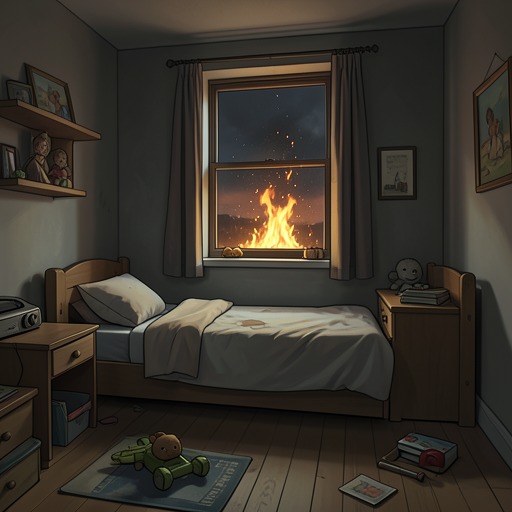
This refusal also defines the emotional architecture of his house. The house is defended against the vampires, but it is equally organized around absences: the absent wife, the absent child, and the absent community of ordinary human beings. Robert Neville’s survival routines keep him moving, yet they repeatedly return him to the people whom survival has taken away. Isolation is consequently not empty space. It is populated by memory, threatened by the possibility of further loss, and sustained by rituals that prevent the dead from becoming entirely unreachable.
The Dog and the Possibility of Attachment
The appearance of a living dog briefly breaks the logic of absolute solitude. On the third morning after Robert Neville has reached a state of despair, he sees the animal wandering across the lawn. The dog stops at the sound of the front door, reacts in fright, and limps away with its tail between its legs. Robert Neville is so shocked that he cannot move. He searches the neighborhood for an hour, calling to it, and returns home devastated when it has disappeared. To him, the dog is not a minor consolation. After so long without a companion, it represents the highest surviving form of life on the planet.
His reaction reveals how isolation changes the scale of attachment. He imagines caring for the dog and wonders whether a dog might survive better than a human because it could hide in spaces the vampires could not enter and might sense their alien nature. Yet even this practical speculation cannot suppress the emotional fact that he wants the animal near him. He has continued to hope that he will find a man, woman, or child like himself, although reason repeatedly tells him that he may be the only one left within the world he can reach. The dog becomes a substitute for the human companionship he has been unable to locate, not because Robert Neville believes it is equivalent to a person, but because loneliness makes any living bond immeasurably precious.
When the dog finally returns, Robert Neville approaches it carefully. The sick animal first cringes and snaps, but quiet speech gradually allows him to touch its neck and caress it. He promises that it will soon be well; the dog licks his palm, and something breaks in his throat as tears run down his face. The scene briefly reverses his usual position as hunter and defender. Instead of killing an infected creature, he tries to nurse one, and instead of treating the animal as evidence, he receives its touch as a response. The dog dies within a week. Its death repeats the structure of his earlier bereavements, converting the promise of companionship into another enforced separation.
The loss does not leave him unchanged. After the dog’s death, Robert Neville no longer needs liquor to forget or escape. He feels a quiet satisfaction as his investigation makes progress and imagines accepting the robe of a hermit without protest. This acceptance is not happiness and does not abolish loneliness; it is a controlled accommodation to a life in which attachment has repeatedly ended in pain. Knowledge gives the isolation a temporary structure, allowing him to endure what emotion alone could not bear.
Ruth, Contact, and the Limits of Solitude
Ruth’s arrival interrupts Robert Neville’s isolation in a more complicated way than the dog’s appearance. He initially treats her as a possible infected threat, subjects her to examination, and tests her reaction to the cross. When she recoils from it, he takes the response as evidence of vampiric identity. His suspicion is inseparable from his solitude: with no trusted community to confirm his judgments, every stranger must be classified by his own experiments, and every attempt at contact can become an act of control.
Ruth’s account exposes the human cost of that method. She has seen her husband torn apart, lost two children to the plague, wandered for a week while hiding at night, and survived on scraps without adequate sleep. Robert Neville has chased, struck, dragged, and confronted her with garlic before declaring that she is infected. Her anger makes visible what his isolation has concealed: his defensive procedures may be rational within his private system, but to another survivor they resemble persecution. Contact therefore does not simply relieve loneliness. It forces him to see himself from outside the walls of his house.
Even after suspicion and fear, the two survivors briefly achieve an intimacy that Robert Neville has imagined but almost abandoned. He draws Ruth against him without hesitation, and they hold each other as people who have survived the same black terror and need one another. For a time, he forgets time and place; the world contracts to the two bodies joined in the night. The embrace is the clearest interruption of his isolation in the evidence: not observation through a window, not a medical test, and not a promise directed toward an animal, but mutual physical recognition.
The connection remains fragile. Robert Neville immediately wants to help Ruth and examine her, returning to the investigative habits through which he manages danger. His desire for intimacy coexists with the need to classify, diagnose, and protect himself. Isolation has become a method of survival so deeply ingrained that even closeness cannot wholly displace it.
Isolation, Knowledge, and the New Human Order
Robert Neville’s loneliness is also intellectual. He believes that others like him might exist somewhere, but doubts that any could be found within a day’s drive of his house. He continues to perform the practical work of defense—placing garlic at the windows, covering the hothouse with nets, burning bodies, and removing the stones the vampires use—while admitting that he will probably never find anyone else. The contradiction is central: his actions are directed toward reducing the vampire population, but his private conclusion is that the reduction will not restore society.
Science offers him a way to transform isolation into inquiry. He studies vampire bodies, germs, flies, mosquitoes, sunlight, and the activity of white corpuscles. The recognition that diseases can be disseminated mechanically by insects helps connect his personal catastrophe to a broader biological process. Later, the realization that bacteria can mutate changes his understanding of the plague and of the beings it has produced. Knowledge does not give him companionship, but it prevents solitude from becoming pure passivity. He can at least make the world intelligible, even while remaining separated from the people who once inhabited it.
The final significance of loneliness and isolation lies in their instability. Robert Neville repeatedly calls himself the only survivor, yet the dog and Ruth prove that absolute solitude is never a secure conclusion. Each encounter brings relief and renewed vulnerability; each loss drives him toward greater emotional numbness and defensive independence. At the same time, the altered society around him may regard him as the isolated abnormality rather than the last representative of normal humanity. His solitude is therefore both personal and historical: he is cut off from others, but the meaning of “others” is itself changing. The concept ultimately marks the painful gap between being alive and belonging to a world.